Aw, Rats!
In a somewhat recent article by Bethany Brookshire published in Science News, Brookshire describes how climate change is likely to lead to hotter cities, and hotter cities correlated with increased rat populations.
In other words, as climate change heats our cities, our cities fill with more rats. And that, of course, means disease, damage to wiring, and all the other unpleasant things associated with rat infestations. (Don't get me wrong, they have their place but in big numbers can become a big problem.)
There was one other feature that correlated with more rats: increased urbanization. In particular, it was the loss of green space that meant more rats. And that is something that's easier for a city to handle on its own, and feeds two birds with one hand. Namely, more green space also keeps cities cooler and helps control climate change.
Think of a specific city. Pick the one where you live if you live in one. If not, pick one you're familiar with or are likely to visit. Think of it filled with disease, and rats, and rat droppings, in the sweltering heat. No good, right? If you'd like to prevent or reverse that situation, then what you want to do is protect green space. There are LOTS of ways to do this:
- If you're looking to buy a house, maybe find one with a big yard that you can be sure to not pave over.
- You might work with neighbors to save, or revitalize, or create a nearby park.
- Avid gardeners could set up a community garden. There are lots of models for this. Some with a simple allotment system, others in partnership with urban farming programs, skill development programs for incarcerated people, or with expectations of donating some or all produce to nearby food banks.
- Architects and developers can design buildings with green roofs, or balconies that allow tenants to add greenery. Lower-traffic can include paving that allows small plants to grow up between the bricks.
These are all quite simple and really only require one person, or a small group, asking "Is there a way to preserve or build green space here?"
However, there are broader and higher-leverage ways to do this as well. They can be done at the community center level, or even more at the city-council level.
For example, I recently wrote a series playing around with some permaculture ideas and whether an existing city could use little more than zoning changes to become massively more sustainable (and more friendly to people with disabilities , and lots of other benefits).
If you don't want to go through all the details by reading the full series, let me sketch out the main details. I used a square 6km (3.7 mi) on a side in north Seattle as the palette for the 'town' of the experiment.
- The town was divided into 25 'village' zones of 6x6 blocks (really, it was 3x6 but Seattle blocks are brick-shaped) separated by generous margins.
- The village blocks were zoned for low rise mixed use. That is, business on the first floor with two floors of residence above. This is somewhat denser than most neighborhoods outside of downtown.
- Apartments and condos were specified to be larger than the city average, so people moving into them got more indoor space than they would have otherwise.
- These changes alone allowed more park land and green space to be introduced in almost every block--fewer rats already!
- The margins around the villages were zoned for small-scale farming; imagine a dozen one- or two-block farms. Replacing concrete with soil means lower temperatures by reversing the heat-island effect.
- Since most daily needs can be accessed on the first floor of your building, or in the block serving as the "village center", there are fewer car trips, so...
- ...roads can be downsized, or in some cases removed. Again, less paving means cooler temperatures and more green space, thus even fewer rats.
- More road reduction can be achieved with better village-to-village shuttles or small frequent buses.
- The increase in density allowed enough space to add even another band around the 'town' of 25 villages to be slowly replaced with forest land.
- Forest provides both shade and habitat for animals that actively hunt rats, such as hawks and eagles.
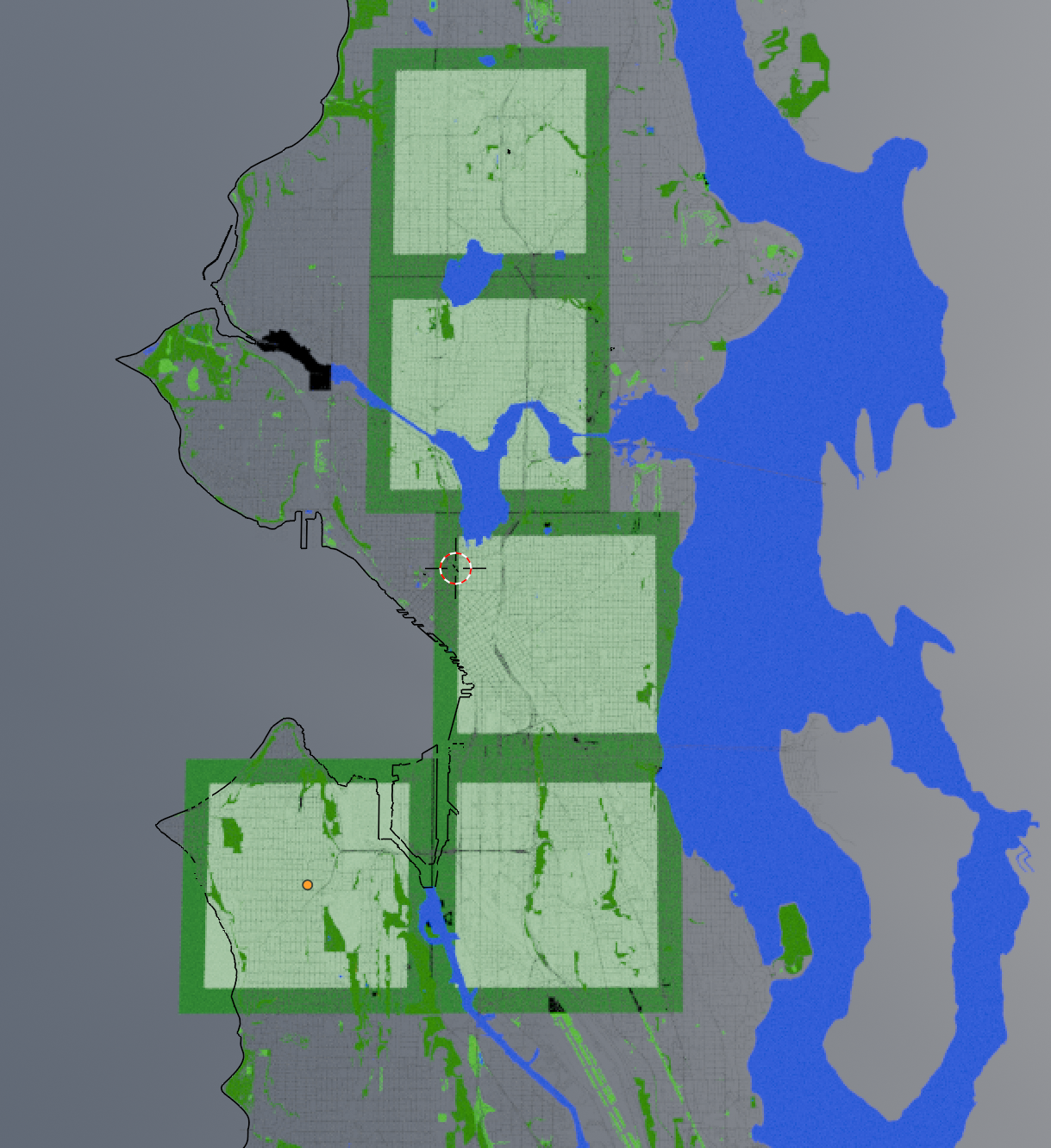
The entire current population of Seattle could reasonably be fit into a plan of about five of these 'towns,' placed throughout what is now the city limits.
In short, a city can be transformed in a way that combats climate change and keeps the rat population low using little more than zoning and development policy that encourages pockets of higher density interspersed with green space. It would happen over the course of a generation, but it wouldn't need to be difficult. Not only would the city you're thinking of be more pleasant, with greenery and gardens, and farms and forest all within walking or short-ride transit distance. It would also be cooler, healthier, and with a lot fewer rats.